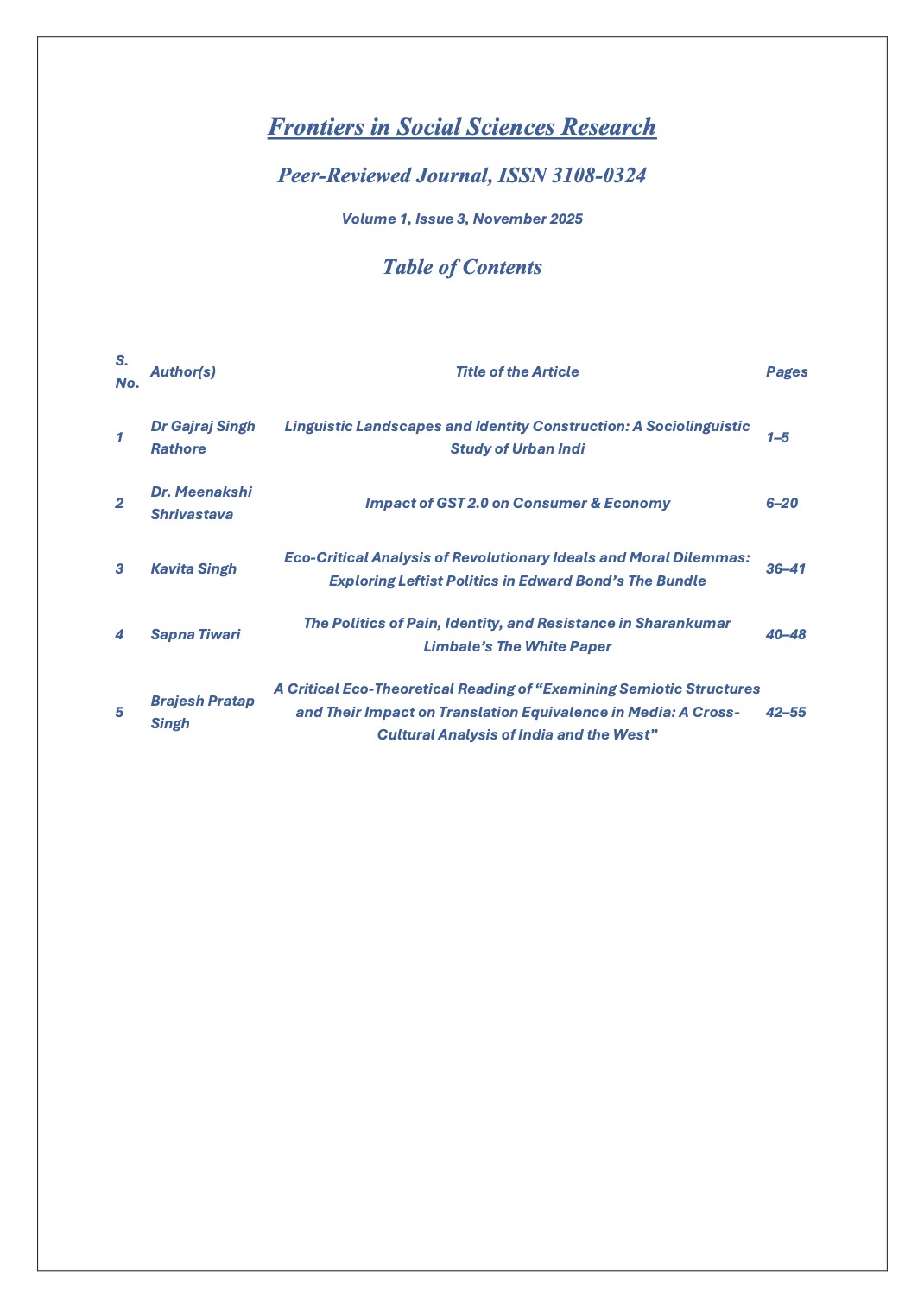
A Critical Eco-Theoretical Reading of “Examining Semiotic Structures and Their Impact on Translation Equivalence in Media: A Cross-Cultural Analysis of India and the West”
DOI:
https://doi.org/10.24113/pw440458Keywords:
Ecocriticism; Eco‑semiotics; Translation equivalence; Semiotic structures; Media ecology; Cultural sustainability; Cross‑cultural analysis; India and the West; Symbolic ecosystems; Posthumanist ecocriticismAbstract
This paper offers a critical eco‑theoretical reading of Examining Semiotic Structures and Their Impact on Translation Equivalence in Media: A Cross‑Cultural Analysis of India and the West by Pandey and Singh. While the original study foregrounds translation equivalence and semiotic mediation across cultural contexts, this review reinterprets the work through the lens of ecocriticism. It argues that translation functions as an ecological process wherein semiotic codes behave like organisms adapting to new cultural environments. By conceptualizing semiotic structures as ecological networks, the paper highlights how translation equivalence parallels ecological balance, cultural sustainability, and biodiversity. The analysis underscores the risks of semiotic homogenization and technological distortion while emphasizing the need to preserve semiotic diversity as a form of cultural conservation. Ultimately, the essay demonstrates that media translation can be understood as a symbolic ecosystem, extending ecocritical discourse into the domain of cultural communication and global media studies.
Downloads
Published
Issue
Section
License
Copyright (c) 2025 Brajesh Pratap Singh (Author)

This work is licensed under a Creative Commons Attribution 4.0 International License.
License Terms (CC BY 4.0)
All articles published in Frontiers in Social Sciences Research (FSSR) are licensed under the Creative Commons Attribution 4.0 International License (CC BY 4.0).
Under this license, readers are free to:
-
Share — copy and redistribute the material in any medium or format
-
Adapt — remix, transform, and build upon the material for any purpose, even commercially provided that the following conditions are met:
Attribution
You must give appropriate credit to the original author(s), provide a link to the license, and indicate if any changes were made.
Attribution should not suggest that the author(s) or the journal endorse your use of the work.
No Additional Restrictions
You may not apply legal terms or technological measures that legally restrict others from doing anything the license permits.
License Link
To view a copy of this license, visit: