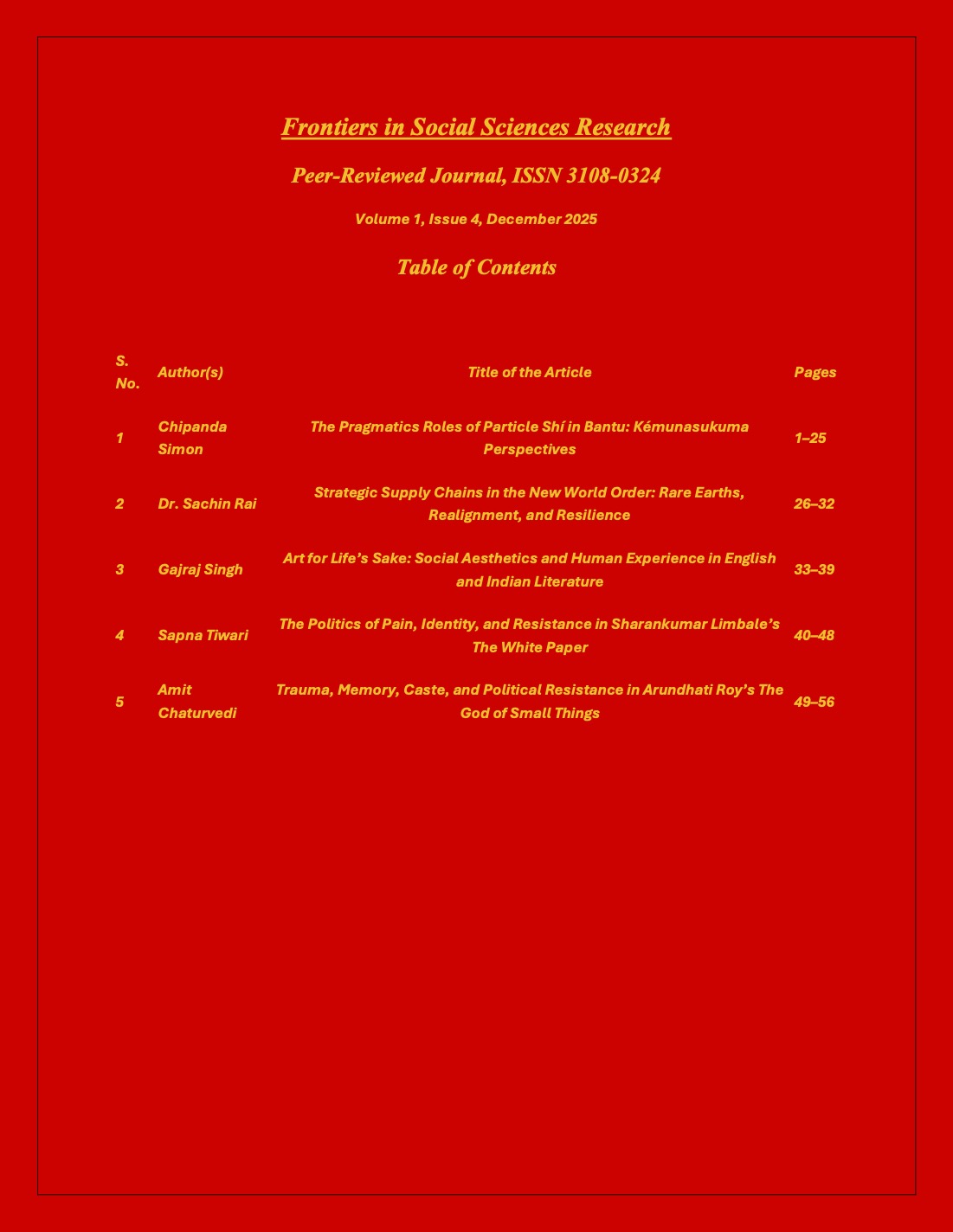
Trauma, Memory, Caste, and Political Resistance in Arundhati Roy’s The God of Small Things
DOI:
https://doi.org/10.24113/kxjyea54Keywords:
Arundhati Roy, caste, trauma, memory, postcolonial literature, Kerala, Velutha, AmmuAbstract
Arundhati Roy’s The God of Small Things (1997) is a landmark postcolonial novel that intertwines personal trauma with political history, exposing the deep-rooted injustices embedded in Indian society. This research paper examines the novel through the lenses of trauma theory, postcolonial criticism, caste studies, and feminist theory. It explores how Roy’s nonlinear narrative structure mirrors the fragmented nature of memory and trauma, how caste and social transgression shape the tragic fate of Velutha and Ammu, and how the novel critiques state violence, patriarchal norms, and political hypocrisy. The analysis argues that Roy’s novel is not merely a story of a family’s disintegration but a profound commentary on the oppressive structures that govern Indian social life. The paper concludes that The God of Small Things exemplifies the power of literature to challenge dominant narratives, expose systemic injustice, and foreground marginalized voices.
Downloads
Published
Issue
Section
License
Copyright (c) 2026 Amit Chaturvedi (Author)

This work is licensed under a Creative Commons Attribution 4.0 International License.
License Terms (CC BY 4.0)
All articles published in Frontiers in Social Sciences Research (FSSR) are licensed under the Creative Commons Attribution 4.0 International License (CC BY 4.0).
Under this license, readers are free to:
-
Share — copy and redistribute the material in any medium or format
-
Adapt — remix, transform, and build upon the material for any purpose, even commercially provided that the following conditions are met:
Attribution
You must give appropriate credit to the original author(s), provide a link to the license, and indicate if any changes were made.
Attribution should not suggest that the author(s) or the journal endorse your use of the work.
No Additional Restrictions
You may not apply legal terms or technological measures that legally restrict others from doing anything the license permits.
License Link
To view a copy of this license, visit: