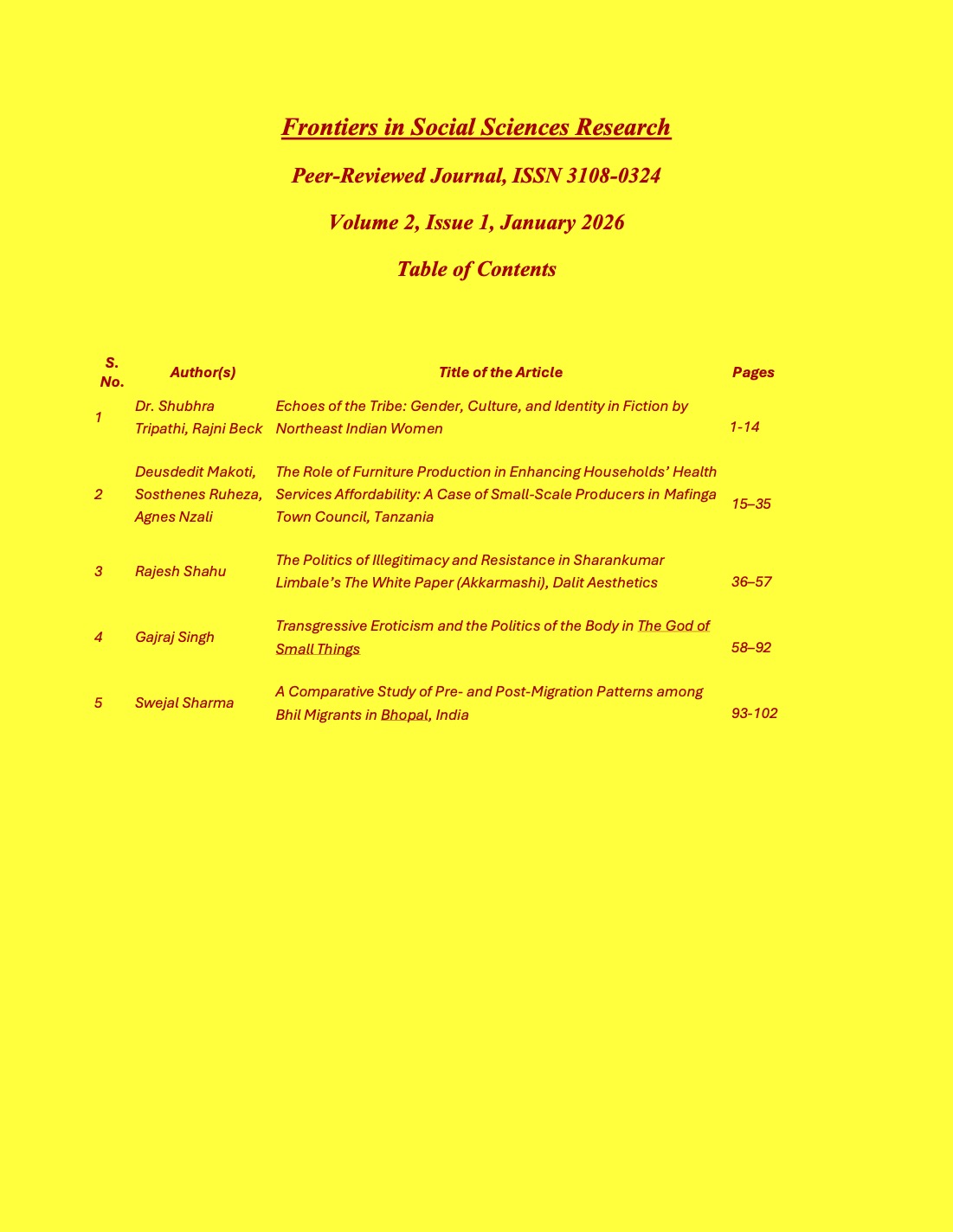
The Politics of Illegitimacy and Resistance in Sharankumar Limbale’s The White Paper (Akkarmashi), Dalit aesthetics
DOI:
https://doi.org/10.24113/dt5ac407Keywords:
Dalit literature, Sharankumar Limbale, The White Paper (Akkarmashi), Dalit autobiography.Abstract
Sharankumar Limbale’s The White Paper (Akkarmashi, 1984) stands as one of the most influential autobiographical narratives in Dalit literature and a foundational text in the articulation of Dalit subjectivity. The text foregrounds the existential crisis of the Akkarmashi—the “half‑caste” born of caste‑transgressive sexual exploitation—and exposes the structural violence embedded in caste society. Through a narrative that oscillates between personal anguish and collective testimony, Limbale documents the psychological fragmentation, social humiliation, and political invisibility imposed upon Dalits by Brahmanical patriarchy. This article examines The White Paper through the lenses of Dalit aesthetics, Ambedkarite thought, and subaltern studies, arguing that Limbale transforms personal trauma into a political document that indicts caste society. The narrative reveals how caste, sexuality, and illegitimacy intersect to produce a life of perpetual exclusion, while simultaneously asserting the agency of the oppressed through the act of self‑representation. Ultimately, the text functions as a counter‑archive that reclaims dignity through testimony, making it a seminal contribution to the canon of Dalit resistance literature.
Downloads
Published
Issue
Section
License
Copyright (c) 2026 Rajesh Shahu (Author)

This work is licensed under a Creative Commons Attribution 4.0 International License.
License Terms (CC BY 4.0)
All articles published in Frontiers in Social Sciences Research (FSSR) are licensed under the Creative Commons Attribution 4.0 International License (CC BY 4.0).
Under this license, readers are free to:
-
Share — copy and redistribute the material in any medium or format
-
Adapt — remix, transform, and build upon the material for any purpose, even commercially provided that the following conditions are met:
Attribution
You must give appropriate credit to the original author(s), provide a link to the license, and indicate if any changes were made.
Attribution should not suggest that the author(s) or the journal endorse your use of the work.
No Additional Restrictions
You may not apply legal terms or technological measures that legally restrict others from doing anything the license permits.
License Link
To view a copy of this license, visit: