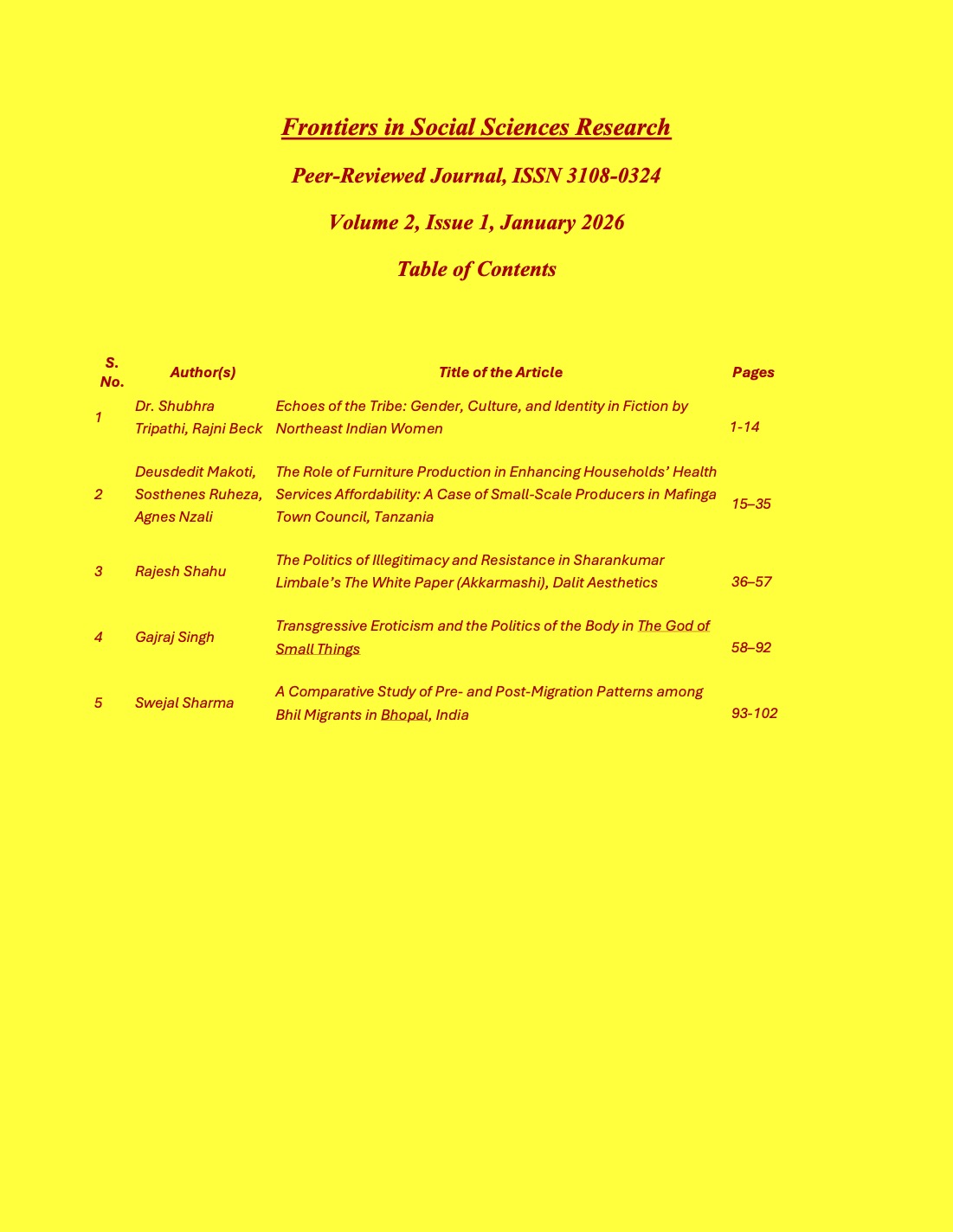
A Comparative Study of Pre- and Post-Migration Patterns among Bhil Migrants in Bhopal, India
DOI:
https://doi.org/10.24113/ftfzkh35Keywords:
Linguistic politics in India, multilingualism, identity and nationalism, sociolinguistics, postcolonial theory, cultural citizenship, Shashi TharoorAbstract
Urban migration among indigenous populations in India is frequently examined through structural lenses of economic marginalization and displacement. Far less attention has been devoted to systematic examination of how migration reorders everyday cultural practices. This paper presents a comparative domain-based analysis of pre- and post-migration cultural patterns among Bhil migrants residing in Bhopal, Madhya Pradesh. Drawing on survey data collected from 100 respondents, the study evaluates transformations across ritual participation, linguistic practices, dress norms, social networks, and identity articulation. Findings demonstrate that cultural change under urban transition is neither linear nor uniform. Public and institutional domains show marked adaptive shifts, while domestic and ritual spaces exhibit significant continuity. The results challenge homogenizing narratives of tribal assimilation and instead highlight selective, structurally mediated cultural reconfiguration. The study contributes to migration sociology and indigenous urban studies by operationalizing domain-specific comparative measurement within a South Asian context.
Downloads
Published
Issue
Section
License
Copyright (c) 2026 Swejal Sharma (Author)

This work is licensed under a Creative Commons Attribution 4.0 International License.
License Terms (CC BY 4.0)
All articles published in Frontiers in Social Sciences Research (FSSR) are licensed under the Creative Commons Attribution 4.0 International License (CC BY 4.0).
Under this license, readers are free to:
-
Share — copy and redistribute the material in any medium or format
-
Adapt — remix, transform, and build upon the material for any purpose, even commercially provided that the following conditions are met:
Attribution
You must give appropriate credit to the original author(s), provide a link to the license, and indicate if any changes were made.
Attribution should not suggest that the author(s) or the journal endorse your use of the work.
No Additional Restrictions
You may not apply legal terms or technological measures that legally restrict others from doing anything the license permits.
License Link
To view a copy of this license, visit: