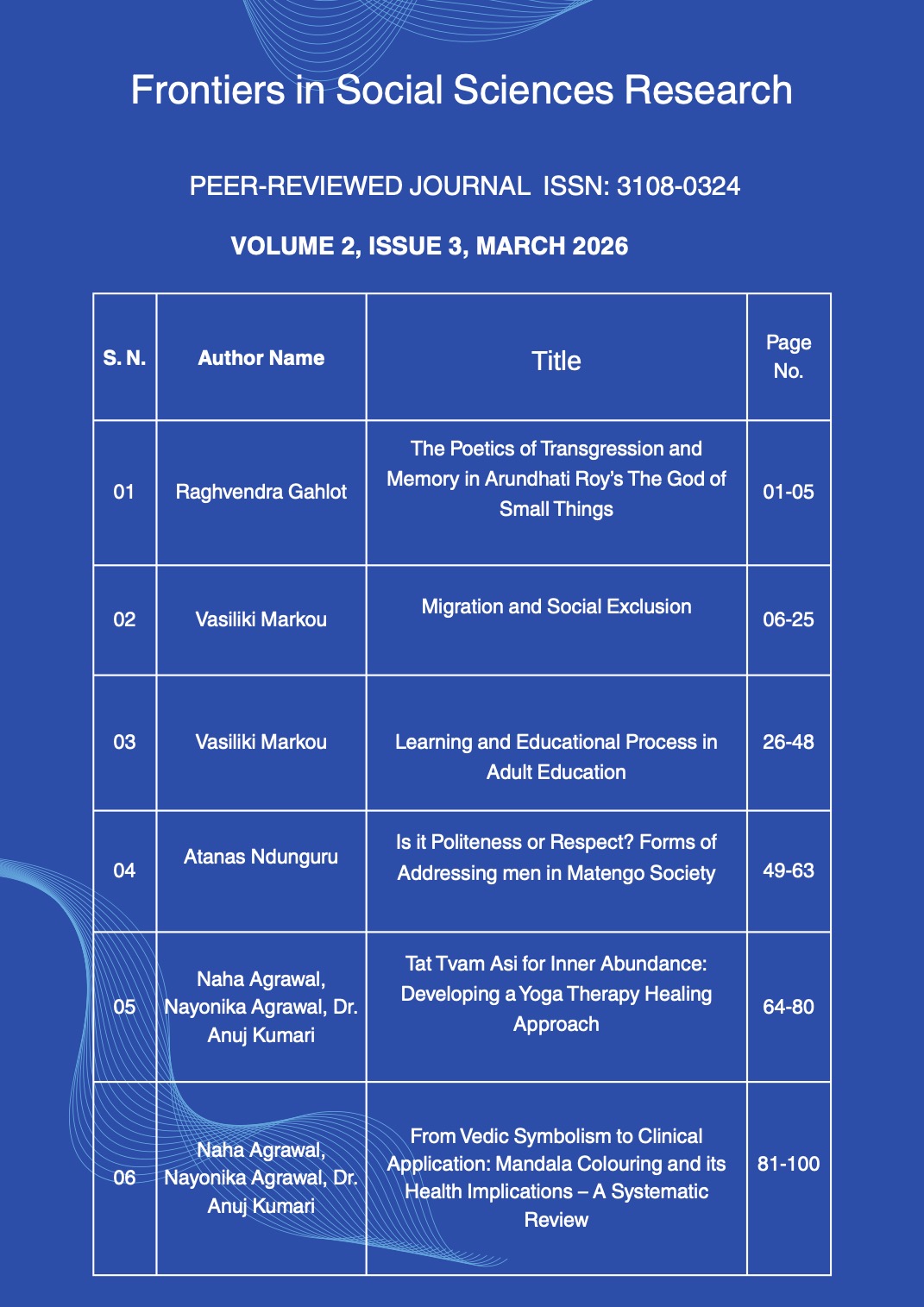
The Poetics of Transgression and Memory in Arundhati Roy’s The God of Small Things
DOI:
https://doi.org/10.24113/ndmk5e89Keywords:
Arundhati Roy, The God of Small Things, caste, gender, memory, transgression, postcolonialism, subalternity, patriarchy, fragmentatioAbstract
Arundhati Roy’s The God of Small Things (1997) remains one of the most influential postcolonial novels of the late twentieth century because of its experimental narrative structure, its critique of caste and gender hierarchies, and its lyrical treatment of memory. This article examines the novel through three interrelated frameworks: the politics of transgression, the aesthetics of fragmentation and memory, and the ethics of “small things” as a counter-discourse to dominant social structures. By foregrounding forbidden love, caste violence, and the intimate perceptions of childhood, Roy constructs a narrative in which the “small” becomes a site of resistance against patriarchy, caste, and state power.
Downloads
Published
Issue
Section
License
Copyright (c) 2026 Raghvendra Gahlot (Author)

This work is licensed under a Creative Commons Attribution 4.0 International License.
License Terms (CC BY 4.0)
All articles published in Frontiers in Social Sciences Research (FSSR) are licensed under the Creative Commons Attribution 4.0 International License (CC BY 4.0).
Under this license, readers are free to:
-
Share — copy and redistribute the material in any medium or format
-
Adapt — remix, transform, and build upon the material for any purpose, even commercially provided that the following conditions are met:
Attribution
You must give appropriate credit to the original author(s), provide a link to the license, and indicate if any changes were made.
Attribution should not suggest that the author(s) or the journal endorse your use of the work.
No Additional Restrictions
You may not apply legal terms or technological measures that legally restrict others from doing anything the license permits.
License Link
To view a copy of this license, visit: