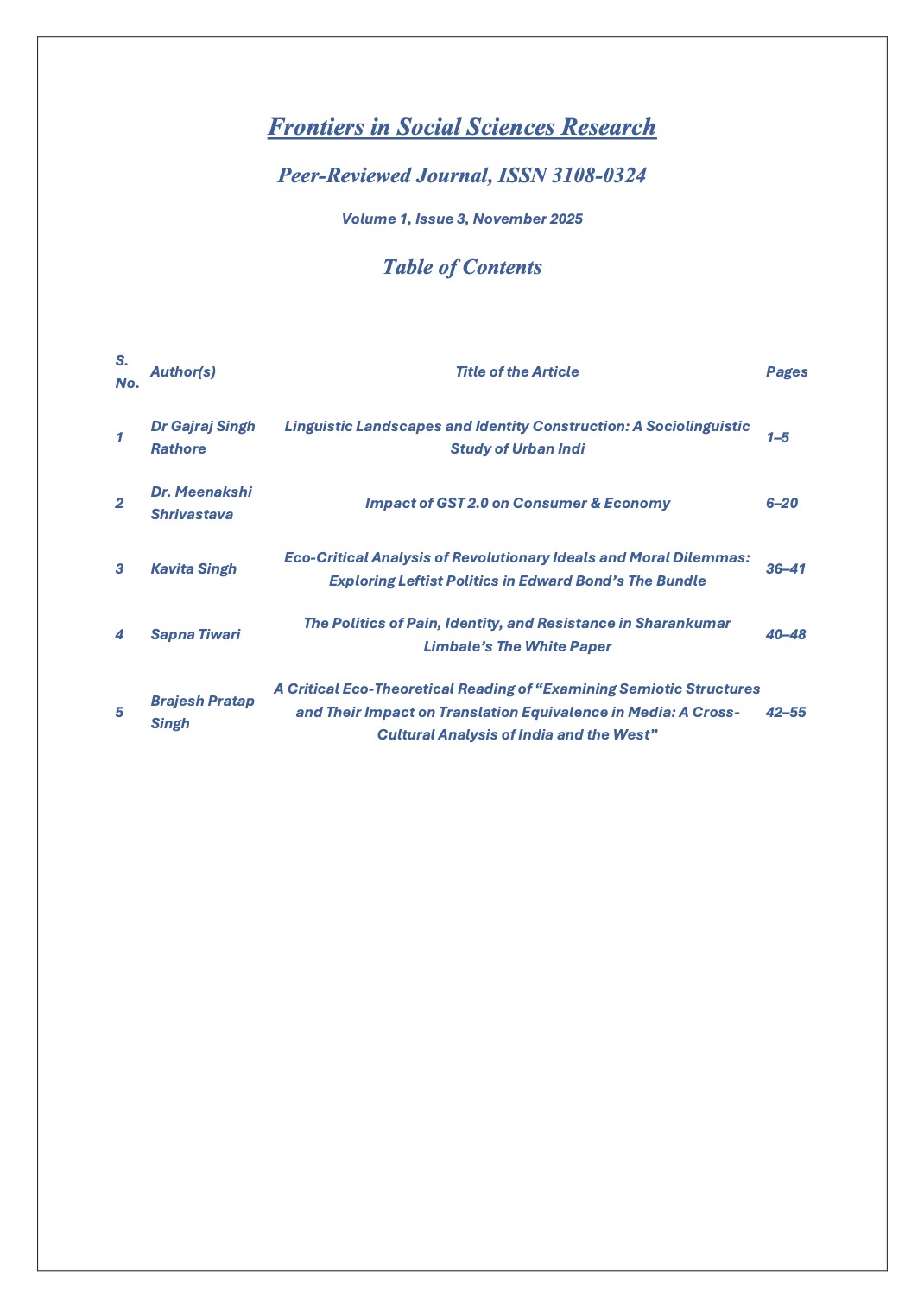
Eco-Critical Analysis of Revolutionary Ideals and Moral Dilemmas: Exploring Leftist Politics in Edward Bond’s The Bundle
DOI:
https://doi.org/10.24113/8zpdsw66Keywords:
Edward Bond; The Bundle; Ecocriticism; Marxism; Revolutionary Politics; Moral Dilemmas; Environmental Humanities; Capitalism; Ecological Justice; Theatre StudiesAbstract
This paper offers an eco‑critical reinterpretation of Edward Bond’s The Bundle, extending Sameeul Haq Nazki’s Marxist analysis by foregrounding ecological dimensions of Bond’s dramaturgy. While Nazki situates the play within revolutionary discourse and class struggle, this study highlights how ecological concerns—scarcity, survival, and environmental degradation—intersect with moral dilemmas and leftist politics. Through the lens of ecocriticism, the river motif and resource scarcity are examined as symbols of both social and ecological precarity. Bond’s critique of capitalism is thus revealed as inseparable from ecological exploitation, urging audiences to envision justice that is simultaneously social and environmental. By integrating environmental humanities into the analysis, the paper demonstrates how Bond’s theatre functions as ecological pedagogy, challenging anthropocentric revolutionary ideals and expanding compassion to include non‑human life. This eco‑critical perspective situates The Bundle as a text of urgent relevance to contemporary debates on climate change, ecological justice, and sustainable futures.
Downloads
Published
Issue
Section
License
Copyright (c) 2025 Kavita Singh (Author)

This work is licensed under a Creative Commons Attribution 4.0 International License.
License Terms (CC BY 4.0)
All articles published in Frontiers in Social Sciences Research (FSSR) are licensed under the Creative Commons Attribution 4.0 International License (CC BY 4.0).
Under this license, readers are free to:
-
Share — copy and redistribute the material in any medium or format
-
Adapt — remix, transform, and build upon the material for any purpose, even commercially provided that the following conditions are met:
Attribution
You must give appropriate credit to the original author(s), provide a link to the license, and indicate if any changes were made.
Attribution should not suggest that the author(s) or the journal endorse your use of the work.
No Additional Restrictions
You may not apply legal terms or technological measures that legally restrict others from doing anything the license permits.
License Link
To view a copy of this license, visit: