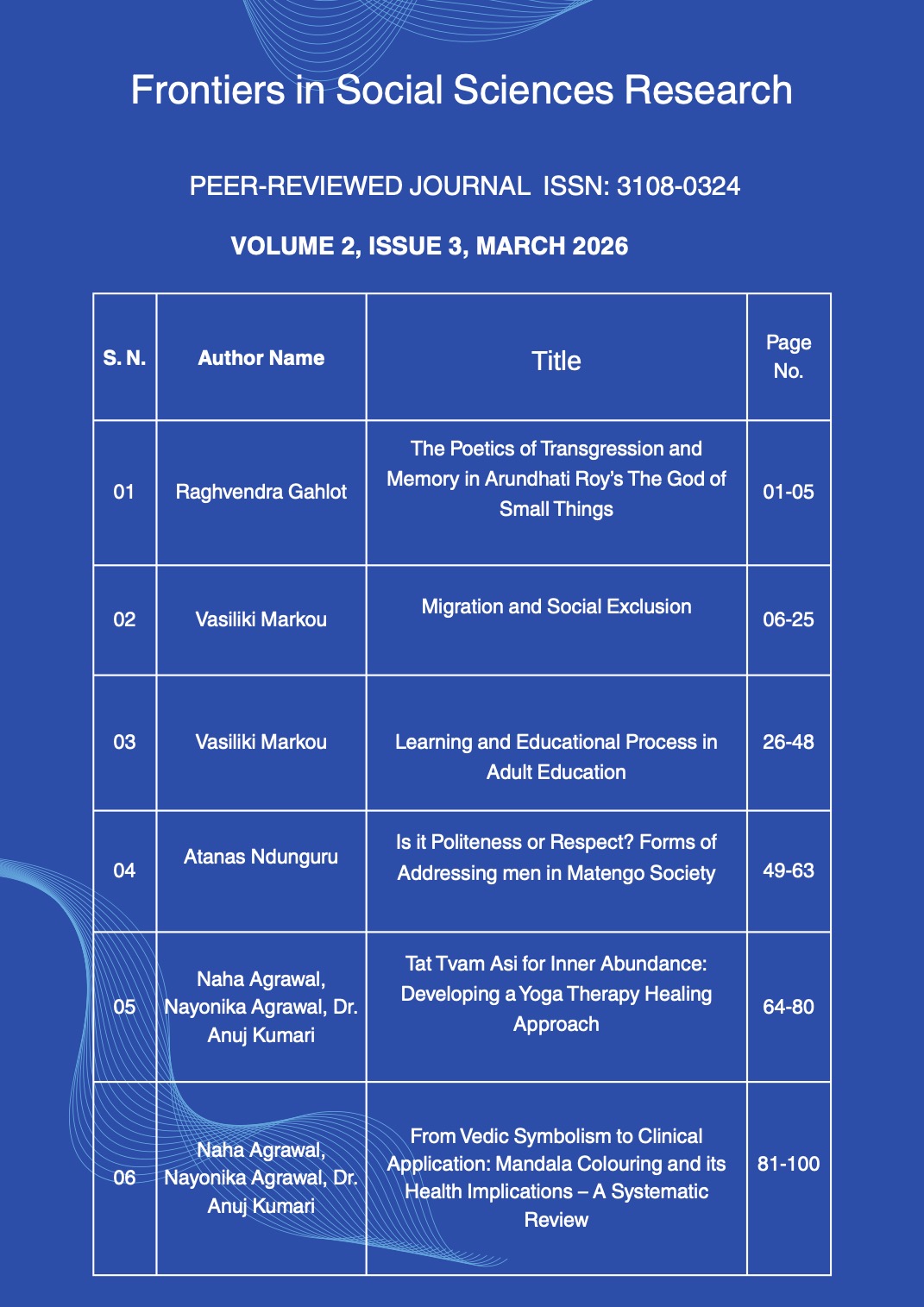
Tat Tvam Asi for Inner Abundance: Developing a Yoga Therapy Healing Approach
DOI:
https://doi.org/10.24113/eaawra74Keywords:
Tat Tvam Asi, Inner Abundance, Advaita Vedanta, Self-Realization, Non-Dualism, Consciousness-Based Healing, Yogic Psychology, Self-Inquiry, Holistic WellbeingAbstract
The present study aims to develop a yoga therapy healing approach grounded in the Vedantic principle of Tat Tvam Asi, which signifies the essential unity of the individual self with universal consciousness. Rooted in Advaita Vedanta, this principle offers a profound philosophical foundation for understanding inner abundance as a state of self-realisation, inner fulfilment, and holistic wellbeing. The study adopts a conceptual and theoretical research design, drawing from classical Vedantic texts, yoga philosophy, and contemporary therapeutic perspectives. Based on philosophical analysis and conceptual synthesis, a structured yoga therapy healing framework is proposed that integrates yogic practices, self-inquiry, and contemplative awareness. The study highlights the relevance of non-dual understanding in addressing inner conflicts, emotional imbalance, and identity-related distress. The findings suggest that integrating Tat Tvam Asi into yoga therapy can enhance its depth by moving beyond symptom management toward consciousness-based healing and inner abundance.
Downloads
Published
Issue
Section
License
Copyright (c) 2026 Naha Agrawal, Nayonika Agrawal, Dr. Anuj Kumari (Author)

This work is licensed under a Creative Commons Attribution 4.0 International License.
License Terms (CC BY 4.0)
All articles published in Frontiers in Social Sciences Research (FSSR) are licensed under the Creative Commons Attribution 4.0 International License (CC BY 4.0).
Under this license, readers are free to:
-
Share — copy and redistribute the material in any medium or format
-
Adapt — remix, transform, and build upon the material for any purpose, even commercially provided that the following conditions are met:
Attribution
You must give appropriate credit to the original author(s), provide a link to the license, and indicate if any changes were made.
Attribution should not suggest that the author(s) or the journal endorse your use of the work.
No Additional Restrictions
You may not apply legal terms or technological measures that legally restrict others from doing anything the license permits.
License Link
To view a copy of this license, visit: