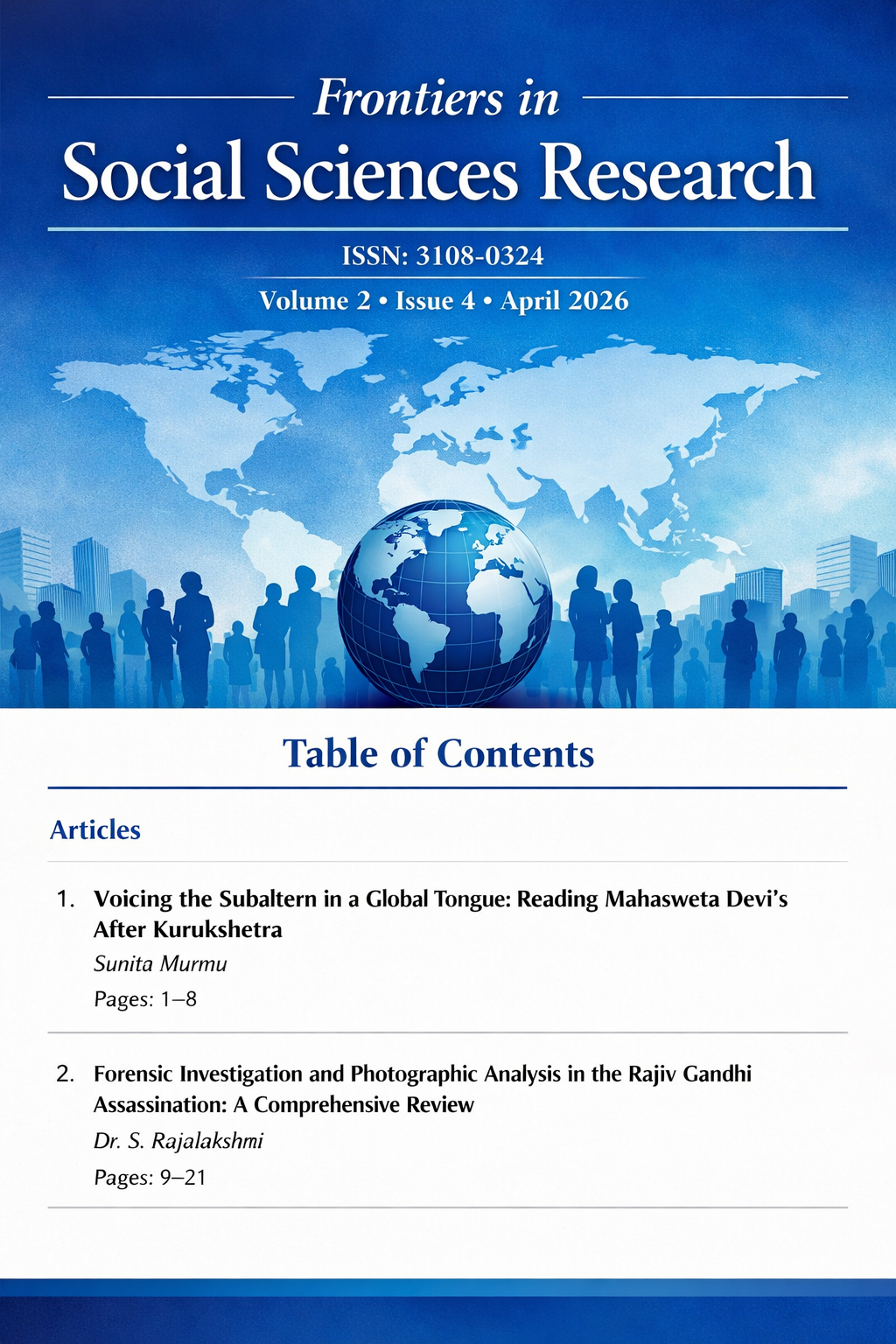
Voicing the Subaltern in a Global Tongue: Reading Mahasweta Devi’s After Kurukshetra
DOI:
https://doi.org/10.24113/qys19j63Keywords:
Mahasweta Devi, Translation Studies, Postcolonialism, Subaltern Voices, Cultural Mediation, Indian Literature, Literary TranslationAbstract
In the contemporary literary landscape of India, Mahasweta Devi has arguably been one of the most widely translated writers in a regional language. A prominent Bengali writer, known for her social and political activism, she not only effectively voiced the struggles of the oppressed and the marginalized peoples but her works continue to draw attention to this section of the Indian society.
Translations of her works into the major Indian languages, including English, not only make them widely available but also broaden their readership, thereby granting the author national and international status and recognition. While translations help mediate culture, it is interesting to note that the theory and practice of translation, as exemplified by Mahasweta Devi’s works, have become a major site of critical inquiry. In the context of postcolonial studies, especially in translation, who and what get translated are matters of debate. It is in this light that the present paper attempts to look at Mahasweta Devi’s After Kurukshetra: Three Stories, translated into English by Anjum Katyal and published by Seagull Books, Calcutta, 2005.
Downloads
Published
Issue
Section
License
Copyright (c) 2026 Sunita Murmu (Author)

This work is licensed under a Creative Commons Attribution 4.0 International License.
License Terms (CC BY 4.0)
All articles published in Frontiers in Social Sciences Research (FSSR) are licensed under the Creative Commons Attribution 4.0 International License (CC BY 4.0).
Under this license, readers are free to:
-
Share — copy and redistribute the material in any medium or format
-
Adapt — remix, transform, and build upon the material for any purpose, even commercially provided that the following conditions are met:
Attribution
You must give appropriate credit to the original author(s), provide a link to the license, and indicate if any changes were made.
Attribution should not suggest that the author(s) or the journal endorse your use of the work.
No Additional Restrictions
You may not apply legal terms or technological measures that legally restrict others from doing anything the license permits.
License Link
To view a copy of this license, visit: